

- Lawn Turf
- Paving & Stone
Get In Touch With Our Experts Today!
Give us a Call! - Composite Decking
- Soil
- Bark
- Dressing
- Artificial
- Timber
- Seed & Fertiliser
Sign up to get our latest news and blog posts in your inbox
August 20, 2026 Summer TurfTurfTurf Tips
After weeks of hot weather, strong sunshine and months of drought, even the healthiest UK lawns can start to look worse for wear. Those once-vibrant green lawns are quickly becoming brown, crispy, and for some, completely dead.
So once the weather returns to normal, what do you do about your turf?
In this article, we explore whether it’s best to reseed, returf or replace your lawn after the heatwaves. We discuss the pros and cons and which option is best for your lawn.
Although your grass may not be showing much life in terms of its colour, thickness and growth, it doesn’t mean it’s dead. During extreme heat, grass naturally goes dormant to protect itself.
A quick way to test if your lawn is dead or dormant is the tug test. Grab a small handful of turf and tug. If there’s resistance, the roots are still anchored and active, and your grass should come back to life once rain arrives.
If, when you tug the turf, the grass blade and root come away easily, then unfortunately, your turf has died from the extreme heat and drought.
Read More: Is My Lawn Dead or Dormant?
Both overseeding and laying new turf can help restore a heat-damaged lawn. However, they suit different situations, budgets, and preferred outcomes.
| Reseeding | Returfing | |
| Best For | Small, bare or thin patches | Extensive lawn damage
|
| Initial Result | Gradual, as it needs to germinate and establish | Instant with a freshly laid, green lawn
|
| Growth Speed | Anything from 3 to 12 weeks depending on conditions | 2 weeks for shallow roots and up to 6 weeks for full establishment
|
| Preparation Required | Soil needs preparing for seeds and application of seasonal fertiliser | Ground needs to be fully prepared and levelled for turf
|
| Best time of year | Spring or autumn when grass is actively growing | Any time of year as long as the ground is not sodden or frozen
|
| Ideal if… | Most of your existing lawn is healthy, you’re on a tighter budget, and you have the time to nurture grass seeds
|
You want to replace a badly damaged lawn and have a fresh, healthy, instant lawn. |
View our range of grass seeds and fertilisers
View our range of natural turf
There isn’t a precise percentage of dead grass that means you must replace a lawn.
Instead, think about the overall condition of your lawn and the amount of work required to repair it.
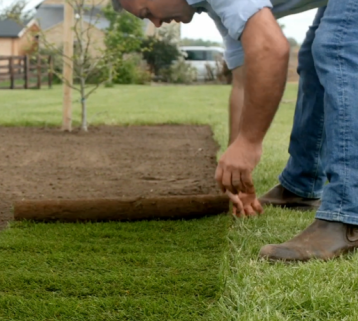
Returfing your lawn may be a great option if:
If you’re fed up with watching your grass struggle with the heat, maybe now’s the time to consider an alternative to natural turf.
This doesn’t mean removing grass altogether. Instead, you could reduce the size of your lawn and introduce different materials and surfaces into your garden, such as:
Installing or extending an existing patio is a great way to reduce your lawn but still create usable space in your garden.
A patio offers more functional space, and porcelain’s strength and durability mean it can withstand the weight of garden furniture, structures, and heavy foot traffic.
With a wide range of porcelain slabs including different colours, sizes and surface patterns, you can find a style that reflects your personality and complements your garden design.
An easy way to break up your turf is by including fun stepping stones or walkways around your garden.
Natural stone such as sandstone, limestone or granite is incredibly strong and highly durable, meaning it can withstand intense pressure for years to come.
And the important part? They’re naturally weather-resistant, so with the right care, they maintain their unique colouring and patterns for years to come too.
Decorative aggregates can turn difficult areas of your lawn or garden into beautifully detailed features. With a range of colours, sizes, and textures, it’s also a quick, easy, and cost-effective way to add depth and colour to your outdoor space.
Gravel can also be used for numerous purposes, including:
Using beautiful natural stone, you can create a focal point within your garden with a cute circular patio.
Our Fossil Mint Sandstone and Raj Green Sandstone Circle Kits provide everything you need to install the perfect round patio.
Again, a round patio can be the main feature of your garden or complement other elements, such as turf, flower beds, or bark.
Composite decking such as Millboard is a wonderful way to add style and sophistication to your garden.
Composite decking in particular requires less maintenance than turf or timber decking, as its specialised coating means it’s UV-resistant, stain-resistant and can withstand the UK climate – winters and heatwaves!
A deck is a statement piece for your garden, plus space for seating, dining, or entertaining. Millboard works particularly well where you want to create distinct zones or tiers, or where turf struggles to grow.
If you’re still unsure what to do with your lawn after a heatwave, start with the condition of your grass to help you decide:
If you’re unsure what’s best for your lawn, don’t hesitate to contact us. Our friendly, knowledgeable team is on hand and happy to answer your questions.
To see whether your lawn is dead or dormant, gently tug the grass. If it remains firmly rooted and you can see green shoots, it’s dormant. If it pulls away with the roots, it’s dead.
Dead grass will not grow back, but brown, dormant grass will once rain falls.
Once temperatures drop and moisture levels rise, yes, you should rake out dead grass and any surface thatch before reseeding or fertilising your lawn.
This comes down to your personal preference, budget and the amount of turf you’re repairing. Overseeding is ideal for small areas, while returfing suits larger areas of dead or poor-performing grass.
No. For the best results when laying new turf, remove all existing turf (dead or alive) and prepare the ground correctly. Our Ultimate Guide on How to Lay Turf can help you here.
 Satisfaction Guaranteed
 99.6% On-Time Delivery
 Open Trade Account