 Satisfaction Guaranteed
 99.6% On-Time Delivery
 Open Trade Account
Sharp Sand – 950kg Bulk Bag
AS LOW AS £77.00£92.40 Ex. VATInc. VAT



Need a loose load? Get in touch with our team to arrange collection from our St. Albans branch.
Whether you're laying a patio, bedding in paving slabs, or mixing mortar, Sharp Sand from George Davies Turf & Stone is the go-to choice for tradespeople and homeowners across Hertfordshire and beyond. Available in a 1 tonne bulk bag for home delivery, or as a tonne scoop collection from our St. Albans branch — whichever suits your project best.
Sharp sand (also known as grit sand or coarse sand) is coarser and more angular than building sand, making it the right material wherever you need strength, stability, and reliable drainage beneath your finished surface.
Sharp sand is the preferred bedding material for laying porcelain paving, natural stone, and block paving. Applied at a depth of 30–50mm, it creates a stable, free-draining layer that holds slabs firmly in place and resists movement over time. Its angular grain structure binds far better than softer building sands, giving you a finish that stays true for years.
Beyond paving, sharp sand plays a vital role throughout a landscaping job. Mixed with cement at a ratio of 6:1, it produces a reliable mortar for bedding heavy slabs or pointing. It's also widely used in drainage channels, as a concrete aggregate when combined with ballast, and as a levelling layer beneath artificial turf or play bark installations.
One tonne of sharp sand covers the following areas depending on the depth you're working to:
| Depth | Coverage per Tonne Bag |
|---|---|
| 25mm | 22.5 m² |
| 50mm | 11.25 m² |
| 75mm | 7.5 m² |
| 100mm | 5.63 m² |
Not sure how many bags you need? Get in touch and our team will help you calculate the right quantity for your project. You can also collect a tonne scoop directly from our St. Albans branch — a handy option if you have a trailer or a tipper vehicle.
High-quality products are only half the story at George Davies; expert delivery and after-care are just as important. From your very first enquiry to the moment your Cloud White Porcelain arrives, every single customer is looked after by our friendly team.
We proudly service Olney, Bedford, St. Albans and the surrounding areas. Operating from our depots in Olney and St. Albans, we can offer a prompt and efficient delivery service for homeowners and professional landscapers alike.
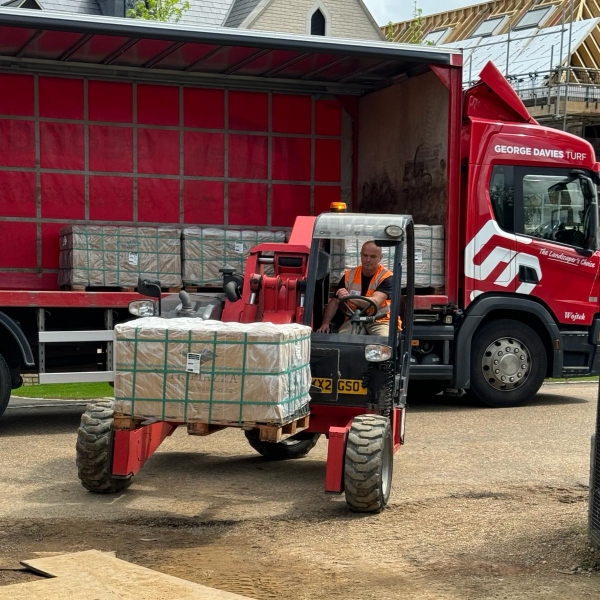
Each delivery of our Cloud White Porcelain is safely stacked onto rigid trucks equipped with forklifts. With the use of What3Words, we can place your porcelain slabs exactly where you need them (within reason).
Long, narrow tracks and gravel driveways are not a problem! Where possible, we can place stone products, turf pallets, and product bulk bags around the back of your property. All we ask is for 9 ft x 9 ft clear access so the forklifts can get through safely.
Our skilled drivers are highly trained, calm under pressure, and expert problem-solvers when it comes to difficult deliveries. If you have restricted areas, tight entrances, or specific requirements, please tell us when ordering and add notes to your online order.
Trust us when we say: our drivers truly make difficult deliveries easy!
This depends on the depth you’re working to and the area you’re covering. As a guide, one tonne of sharp sand covers 22.5 m² at 25mm, 11.25 m² at 50mm, 7.5 m² at 75mm, and 5.63 m² at 100mm. For a standard patio bedding layer at 40mm, one tonne covers approximately 14 m². If you’re unsure, get in touch and our team will calculate the right quantity for you.
Sharp sand (also called grit sand or coarse sand) has a coarser, more angular grain than building sand, which is finer and softer. This makes sharp sand the better choice for paving bedding layers, drainage, and concrete mixes — anywhere you need structural strength. Building sand is softer and used mainly for mortar and bricklaying. If you’re laying paving, always use sharp sand in the bed.
Yes — Sharp Sand is available as a tonne scoop collection from our St. Albans branch. This is a popular option for landscapers and builders with a trailer, tipper van, or grab lorry. Contact us to arrange your collection time and we’ll have it ready for you.
For most paving applications — patios, paths, and flags — a bedding layer of 30–50mm is recommended. For block paving, 40mm is standard. The sharp sand should be loose and screeded level before slabs are laid; do not compact it beforehand. Remember that the sand layer will compress slightly once the slabs are tapped in and the installation is compacted.
Yes. Sharp sand is used in concrete mixes (combined with ballast) and in bedding mortar for heavier slabs (typically 6:1 sharp sand to cement). It is not ideal for fine pointing or bricklaying mortar, where softer building sand is more appropriate. For guidance on the right mix for your project, our team is happy to help — give us a call.
Our bulk bags are large woven polypropylene bags (also called jumbo bags or one-tonne bags) measuring approximately 90cm x 90cm x 90cm when filled. They are delivered by our Manitou telehandler and can be placed on a driveway, hardstanding, or roadside. Please ensure there is clear vehicle access of at least approx. 2.2m (7ft) wide for the vehicle. Let us know of any access restrictions when you place your order.
Tools required:
Follow these four steps to get the best results from your Sharp Sand:
Step 1: Prepare the sub-base
Before applying sharp sand, ensure you have a compacted sub-base in place — typically 100mm of MOT Type 1. The sub-base should be level with a slight fall (1:60) away from any buildings for drainage. Do not skip this step — sharp sand alone is not a substitute for a proper sub-base.
Step 2: Lay the sharp sand bedding layer
Spread the sharp sand evenly over the compacted sub-base to a depth of 30–50mm (a depth of 40mm is most common for patio slabs). Use screed bars to achieve a consistent depth, and a float or straight edge to level it off. Do not compact the sand at this stage — it should remain loose so slabs can be tapped into position.
Step 3: Position your slabs or block paving
Place your paving slabs or blocks onto the screeded sand bed, working from one corner outward. Use a rubber mallet to tap each slab level, checking with a spirit level as you go. Maintain consistent joint gaps using plastic spacers. Avoid walking on freshly laid slabs.
Step 4: Compact and finish
Once all slabs or blocks are in place, use a plate compactor (with a rubber pad to protect the surface) to bed the material firmly into the sand. For block paving, brush kiln-dried sand into the joints afterwards to lock everything in place. For natural stone or porcelain, apply a patio grout to fill the joints once the bedding has set.
Helpful Guides: