 Satisfaction Guaranteed
 99.6% On-Time Delivery
 Open Trade Account
Granite Dust – 950kg Bulk Bag
AS LOW AS £72.00£86.40 Ex. VATInc. VAT



Need a loose load? Get in touch with our team to arrange collection from our St. Albans branch.
Granite Dust from George Davies Turf & Stone is a fine, crushed granite aggregate used across a wide range of landscaping and construction applications. Available as a loose scoop collection from our St. Albans branch, it is the practical choice for landscapers and builders who need a versatile, fine aggregate for path surfacing, binding layers, and levelling work.
Granite dust (also known as granite fines or crusher dust) is produced when granite stone is crushed. Its fine, angular particles compact tightly together, creating a firm and stable surface that binds naturally over time — without the need for additional binders or resins.
Granite dust is one of the most popular loose surface materials for garden paths, driveways, and parking areas. Unlike rounded gravel, granite dust's angular particles bind together under foot traffic and rainfall, creating a firm, stable surface that doesn't displace or scatter. Laid at a depth of 50–75mm over a compacted sub-base of MOT Type 1, it produces a smart, low-maintenance path surface that holds its shape season after season.
Beyond path surfacing, granite dust has a number of practical uses on site. It is used as a fine levelling layer beneath artificial turf, as a jointing material between large stepping stones, and as a drainage-improving additive in heavy clay soils. Its fine consistency also makes it useful as a bedding layer for smaller paving elements and as a top dressing for existing gravel paths that have thinned over time. Pair it with decorative aggregates for a complete path or driveway solution.
One tonne of granite dust covers the following areas depending on the depth you are working to:
| Depth | Coverage per Tonne |
|---|---|
| 25mm | approx. 25 m² |
| 50mm | approx. 12.5 m² |
| 75mm | approx. 8 m² |
Not sure how much you need? Get in touch and we'll help you work out the right quantity for your project. You can collect a loose scoop directly from our St. Albans branch — flexible, quick, and no minimum order required.
High-quality products are only half the story at George Davies; expert delivery and after-care are just as important. From your very first enquiry to the moment your Cloud White Porcelain arrives, every single customer is looked after by our friendly team.
We proudly service Olney, Bedford, St. Albans and the surrounding areas. Operating from our depots in Olney and St. Albans, we can offer a prompt and efficient delivery service for homeowners and professional landscapers alike.
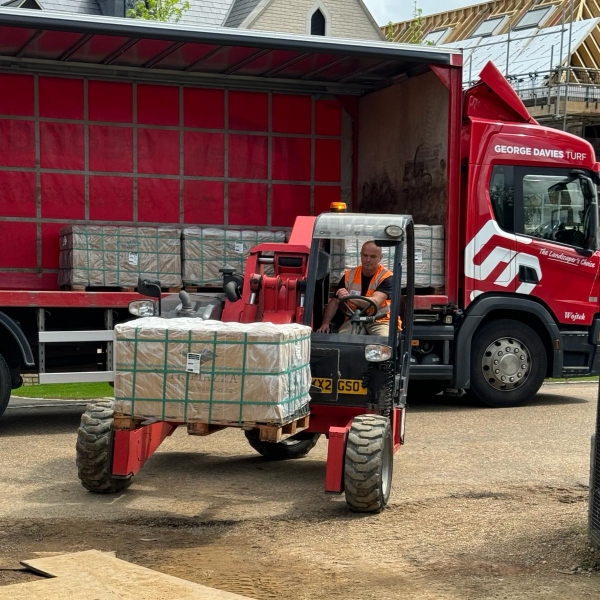
Each delivery of our Cloud White Porcelain is safely stacked onto rigid trucks equipped with forklifts. With the use of What3Words, we can place your porcelain slabs exactly where you need them (within reason).
Long, narrow tracks and gravel driveways are not a problem! Where possible, we can place stone products, turf pallets, and product bulk bags around the back of your property. All we ask is for 9 ft x 9 ft clear access so the forklifts can get through safely.
Our skilled drivers are highly trained, calm under pressure, and expert problem-solvers when it comes to difficult deliveries. If you have restricted areas, tight entrances, or specific requirements, please tell us when ordering and add notes to your online order.
Trust us when we say: our drivers truly make difficult deliveries easy!
Granite dust is most commonly used as a path and driveway surfacing material. Its fine, angular particles compact and bind naturally, creating a firm, stable surface without the need for additional binders. It is also used as a levelling layer under artificial turf, a jointing material between stepping stones, and a drainage additive in heavy clay soils.
Yes — granite dust is self-binding. Unlike rounded gravel, its angular particles lock together under compaction and rainfall, creating a surface that firms up over time. Laid over a compacted MOT Type 1 sub-base and contained within edging, it produces a stable path surface that holds its shape well.
At a depth of 50mm, one tonne of granite dust covers approximately 12.5 m². For a standard garden path that is 1m wide and 10m long (10 m²), one tonne at 50mm depth will be sufficient with a little to spare. Calculate your area (length x width) and divide by the coverage at your chosen depth. If in doubt, get in touch and we’ll help you work it out.
MOT Type 1 is a coarser aggregate graded at 0–40mm, used as a structural sub-base beneath paving, driveways, and hard-standing. Granite dust is a much finer material, used as a surface layer or binding course on top of the sub-base. A well-built path will typically have MOT Type 1 as the base and granite dust as the finished surface above it.
Yes — granite dust works well as a fine levelling layer beneath artificial turf. Applied over a compacted sub-base, a thin layer of granite dust (15–25mm) creates a smooth, even surface for the turf to sit on. It provides good drainage and a firm, consistent base that won’t shift or settle under the turf over time.
Tools required:
Step 1: Prepare the sub-base
Excavate to a depth that allows for your sub-base and granite dust layers. For a garden path, excavate to around 150–175mm. Lay a compacted sub-base of MOT Type 1 at 100mm depth and compact thoroughly with a plate compactor. A firm, even sub-base is essential for a long-lasting granite dust surface.
Step 2: Install edging
Fix path edging boards or stone kerbing along both sides of your path or driveway before laying the granite dust. This keeps the material contained and prevents it spreading onto surrounding planting or lawn areas over time. A clearly defined edge also gives the finished path a neater, more professional appearance.
Step 3: Spread the granite dust
Tip the granite dust into the prepared area and spread it evenly with a rake to a depth of 50–75mm. For a lighter use path, 50mm is typically sufficient. For a driveway or high-traffic area, aim for 75mm. Rake out any ridges and work toward a consistent, even surface across the full width of the path.
Step 4: Compact and finish
Compact the granite dust with a plate compactor in overlapping passes. The material will bind and firm up as it compacts. After the first compaction, check the surface level and add or redistribute material as needed before making final passes. The surface will continue to firm up further as it is used and exposed to rainfall.
Helpful Guides: